A Question Jar for a Quiet Gathering
A question jar for a quiet gathering gives guests a gentle way to begin, choose their level of participation and finish without pressured disclosure.
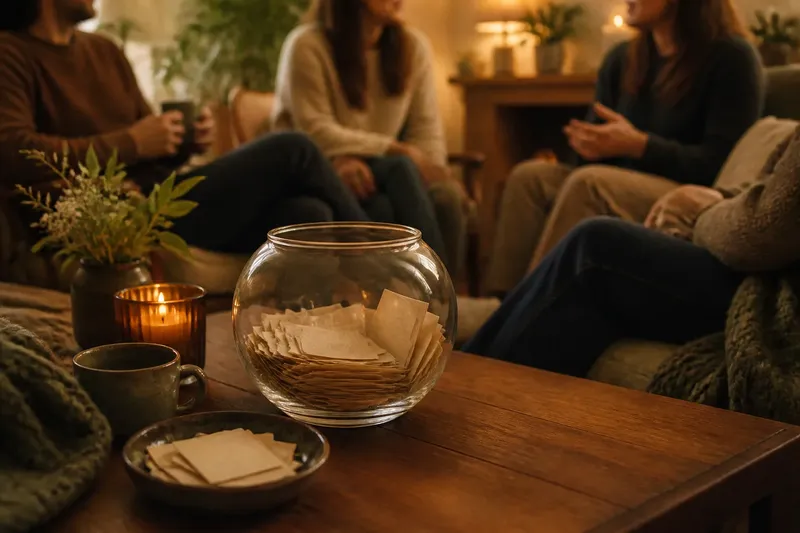
A question jar for a quiet gathering works best when nobody has to draw, answer or explain a refusal. Put a few open-ended prompts within reach, make the options clear, and let the jar serve the room rather than dictate its pace. The useful decision is not simply which questions to include: it is whether guests will take turns drawing, choose their own prompt, or read without answering.
Those approaches can all suit a small gathering, but they create different kinds of invitation. A turn-based draw makes a shared activity easy to understand; self-selection gives people more control; and a read-only jar lets conversation emerge without making any one person its focus. You can choose one format or combine them, provided the choices are explained before the first prompt appears.
What makes a question jar feel optional?
Make the jar visible but not central. A glass bowl on a side table or a small tin beside the tea can invite curiosity without signalling that everyone must gather round. If the group is already settled in a circle, place it where guests can reach it without making a performance of taking a slip.
Say plainly that people may answer, pass, choose a different prompt or simply listen. Mention that nobody needs to explain a pass. This is more useful than a vague assurance that the activity is “casual”: guests need to know what they can do if a question does not suit them.
Keep the prompts open-ended but modest in emotional demand. A question about a small pleasure, an object someone keeps nearby or a place where they like to pause can invite a story without requiring a confession. Avoid wording that assumes everyone has a particular family, home, job, holiday tradition or happy memory. A prompt should leave room for an ordinary answer, an imaginative one or no answer at all.
It also helps to distinguish a personal question from an invitation to disclose something private. “What is a sound you enjoy?” can be answered in a few words. “What is the hardest thing you have been through?” carries a different expectation, even if the person asking intends kindness. A quiet gathering does not need emotional excavation to become meaningful.
Should guests draw a prompt in turn?
With a turn-based draw, one guest takes a slip, reads it aloud and decides whether to answer. The next person can volunteer to draw, or the jar can simply remain available to anyone who wants it. Avoid making the order of the room determine who is “up next”; that can turn a gentle invitation into a round in which silence feels conspicuous.
This approach suits guests who like a shared focus and find it easier to respond to the same prompt than to invent a topic. It can also help a gathering move beyond logistical chat. The trade-off is that a single question can briefly direct everyone’s attention towards the person holding the slip. Keeping the pass visible and ordinary matters especially here.
Imagine a few neighbours sharing supper after a busy week. One person draws, reads, “What is something you like doing slowly?”, and passes because they would rather listen. Another guest answers with a description of making tea; someone else adds a detail about tending a windowsill plant. The expected observable result is a conversation that has a shared starting point, while the first guest remains included without having to explain their choice.
If you use this format, let the answer set the conversational length. A brief reply need not be followed by a string of probing questions. Guests can respond with a related thought, or the group can leave a little space before moving on. The jar offers a beginning, not a requirement to produce a polished story.
Would self-selection suit your group better?
For self-selection, put the slips face up in a shallow bowl, or write the prompts on cards that guests can browse. People may choose a question that feels comfortable, pass a card to someone else only if that person welcomes it, or return the prompt untouched. This format makes choice visible before anyone answers.
Self-selection often suits a group with different comfort levels or a mixture of familiar and newer acquaintances. Someone can choose a light question, while another person may prefer a reflective one. It is also useful when guests arrive at different times: a newcomer can join without having missed an opening round or being asked to catch up.
The possible drawback is that browsing can feel like a small decision in itself. Keep the selection simple. A handful of cards is easier to approach than a crowded spread, and you can include a few prompts with different tones rather than sorting them into elaborate categories. If a guest seems unsure, let them watch or join the conversation without choosing.
Self-selection changes the social emphasis: the person answering has chosen the subject, but the group still needs to respect the boundaries of the answer. A guest who picks a question about a favourite meal has not necessarily invited a discussion of their family history or health. Respond to what they have offered rather than treating the prompt as permission to ask for more.
Could the jar be for reading, not answering?
A read-only version treats prompts as conversation starters rather than turns. Anyone may draw a slip and read it aloud; the group can respond, offer a thought of their own or let the question sit. Nobody is assigned to answer. This can work well for a quiet group that prefers conversation to move between people without a formal sequence.
It is also the least exposing option for a gathering where guests do not know one another well. The question belongs to the room, not to the person who drew it. If replies begin to feel forced, the host can put the slip aside and return to the ordinary conversation.
There is a small distinction between an open discussion and a question directed at one guest. Avoid reading a prompt and then turning to a particular person with an expectant pause. Instead, leave a beat for anyone to speak, or offer a neutral invitation such as, “Does anyone have a thought about that?” If nobody responds, move on without treating silence as a problem to solve.
This format may feel less satisfying to guests who enjoy a clear turn or want a chance to share a personal story. You can accommodate both preferences by allowing volunteers to answer without asking the rest of the group to follow. The format should preserve choice in both directions: permission to speak and permission not to.
How should you choose, phrase and end the prompts?
Choose the format by considering what would make participation easiest for this particular gathering. If guests appreciate a common focus, try a gentle volunteer-led draw. If people may want different levels of personal reflection, offer visible self-selection. If the group is shy or still getting acquainted, let the prompts be read aloud without assigning answers.
For the slips themselves, use plain paper and a broad-tip pen, or print cards in a readable type size. Write one question per slip so a guest does not have to choose between several demands at once. A small set can include different kinds of invitations:
- “What small thing made an ordinary day better recently?”
- “Is there an object you enjoy having nearby?”
- “What kind of place helps you settle in?”
- “What is something you would like to learn about, even casually?”
- “What is a simple sound, smell or flavour you enjoy?”
These are starting points, not a test of whether someone has an interesting answer. Guests can answer literally, tell a brief story, invent a response or pass. If you are preparing prompts for people with different backgrounds, avoid questions that presume a shared custom or a particular kind of household. A useful prompt leaves several honest ways to respond.
Decide how the gathering will end before the jar becomes the centre of attention. You might say that the activity will finish when the tea is poured, when the conversation naturally shifts, or when the last interested person has had a turn. Then close it with a simple line: “Let’s leave the jar there and go back to supper.” Do not ask each guest to report what they learned or name the most revealing answer; that can make a light activity feel like a debrief.
What do guests usually want to know?
What if nobody wants to draw?
Leave the jar available and carry on with the gathering. You can draw one yourself and answer, read a prompt without directing it at anyone, or leave the activity unused. The absence of a response is information about the room’s mood, not an obligation to persuade people.
How can a guest pass without explaining?
Agree in advance that “pass” is enough, and respond with “Of course” before moving on. Avoid asking whether the guest is sure or offering a substitute question unless they request one. A calm, ordinary response makes the option credible for everyone.
Should the host answer the prompts too?
Yes, if you want to, but keep your answer proportionate to the question and the setting. A host who volunteers a small response can show that brief answers are welcome; a host who prefers not to answer can model passing just as clearly.
How many prompts should go in the jar?
Use enough for guests to have a choice, but not so many that selecting one becomes the activity. A small, varied collection is often easier to browse than a thick stack, and you can add or remove slips as you notice which wording feels too narrow or too personal.
What should the jar leave behind?
A well-used question jar does not need to produce a striking story or keep every guest talking. It can simply give people a shared point of departure, a few ways to join in and a graceful way to stop. Notice which prompts led to easy conversation and which felt awkward, then revise the wording for another time.
For a question jar for a quiet gathering, the most useful measure is whether guests could choose their own degree of participation. Keep that choice visible from the first invitation to the final pause, and the jar can remain what it was meant to be: a small aid to conversation, not a demand for disclosure.